Judgement?

“Will the Body of Christ Be at the Great White Throne Judgment?”

No. The Great White Throne Judgment is not for the Body of Christ, but for the unbelieving dead.

Revelation 20:11-15 describes this final judgment, where the dead are judged “according to their works.” Those not found in the Book of Life are cast into the lake of fire.

But we, the Body of Christ, are not appointed to wrath (1 Thessalonians 5:9). We have already been judged — not by works, but by faith — at the cross. Christ bore our judgment.

Romans 8:1

“There is therefore now no condemnation to them which are in Christ Jesus.”

2 Corinthians 5:21

“For he hath made him to be sin for us… that we might be made the righteousness of God in him.”

Instead, we will appear at the Judgment Seat of Christ (Romans 14:10; 2 Corinthians 5:10), not to determine salvation, but for reward — to receive according to what we’ve done in the body after salvation.

We are secure, sealed (Ephesians 1:13), and complete in Him (Colossians 2:10). The White Throne is not for the saved, but the lost.

Question.

What does it mean to have mustard seed faith?

Macro image of a female hand holding a mustard seed. The mustard seed is often seen as a symbol of faith and belief because of various biblical passages.

Answer.
Faith is so vital to the Christian life that Scripture tells us that, without it, it is impossible to please God (Hebrews 11:6). Yet faith is such a powerful gift from God (Ephesians 2:8–9) Christ told His disciples that, with just a tiny measure of it, the size of a mustard seed, they could move mountains. So, what does it mean to have “mustard seed faith”?

We see the reference to “mustard seed faith” twice in Scripture. First, in Matthew 17:20, we see Christ’s disciples unable to exorcise a demon from a young boy, even though Jesus had previously given them the authority to do this very thing (Matthew 10:1). When they inquired of Jesus why they were not able to drive the demon out, the Master replied, “Because you have so little faith. I tell you the truth, if you have faith as small as a mustard seed, you can say to this mountain, ‘move from here to there’ and it will move; Nothing will be impossible for you” (Matthew 17:14–20). Next, in Luke 17:6, Jesus tells His disciples, “If you have faith as small as a mustard seed, you can say to this mulberry tree, ‘Be uprooted and planted in the sea,’ and it will obey you.” By using the uncommonly small mustard seed as an example, Jesus is speaking figuratively about the incalculable power of God when unleashed in the lives of those with true faith.

We know that this statement about moving mountains and uprooting trees by faith is not to be taken literally. The key to understanding the passages is the nature of faith, which is a gift from God. The power of faith reflects the omnipotent nature of the God who bestows faith on His own. The mustard seed is one of the tiniest seeds found in the Middle East, so the conclusion is that the amount of faith needed to do great things is very small indeed. Just as in the parable of the mustard seed (Matthew 13:31–32), Jesus uses rhetorical hyperbole to make the point that little is much when it comes from God. The mustard seed in the parable grows to be a huge tree, representing the tiny beginnings of Christianity when just a few disciples began to preach and teach the gospel. Eventually, the kingdom grew to huge proportions, encompassing the entire world and spreading over centuries.

So, too, does the tiniest bit of faith, when it is true faith from God, grow to immense proportions in the lives of believers and spreading out to influence all they come into contact with. One has only to read histories of the great men of the faith, such as Foxe’s Book of Martyrs, to know that superhuman feats were performed by those whose faith was, at one time, only the size of a mustard seed.

777?

What Is the Meaning of 777 in the Bible?

Whitney Hopler

What Is the Meaning of 777 in the Bible?

The number 777 is sometimes known as “God’s number” because it symbolizes significant biblical concepts. Multiples of seven show up throughout the Bible in ways that connect God’s work with fullness, completion, and perfection. Here’s the 777 meaning in the Bible, and how that can inspire us to live with faith.

When the number 7 is repeated 3 times as the number 777, it means the perfection of the Trinity (God the Father, Jesus Christ the Son, and the Holy Spirit), according to the number’s use in Hebrew tradition. The biblical meaning of 777 encompasses both the threefold expression of a perfectly holy God and the full completion symbolized by the number seven. So, 777 signifies God working to completely fulfill good purposes, and doing that work with absolute perfection.

Where Is 777 Mentioned in the Bible?

The only time that the Bible specifically mentions 777 directly is in a verse about Noah’s father Lamech: “Altogether, Lamech lived a total of 777 years, and then he died” (Genesis 5:31). That’s more than just a report of one man’s extraordinarily long lifetime. It indicates the completion of one phase of creation on earth before the worldwide flood, which wiped out all human life except for Noah’s family.

Although that’s the only direct biblical reference to 777, the Bible mentions the number seven or multiples of seven more than 700 times – including a few references to the number seven three different times, which tie into the significance of 777. Triple sevens in scripture show something that has been divinely ordained is being perfectly fulfilled.

Genesis 2:2-3 shows the number seven three times, in its report of what God did after he had completed creating heaven and earth: “By the seventh day God had finished the work he had been doing; so on the seventh day he rested from all his work. Then God blessed the seventh day and made it holy, because on it he rested from all the work of creating that he had done.” The repetition of seven three times here indicates the perfect fulfillment of God’s creation work.

In Joshua 6:3-4, God commanded the Israelite people to march around the city of Jericho for seven days, and on the seventh day to have seven priests blowing horns seven times. When they did so, Jericho’s walls miraculously fell down, empowering the Israelites to move forward into Jericho as God had called them to do. This passage repeats the number seven three times, showing that the barriers to the fulfillment of God’s plan fell down so that God’s perfect purposes could be fulfilled.

The apostle John describes seven churches and seven spirits before God’s throne in Revelation 1:4, during one of his seven letters to churches. In this passage, the use of a triple seven shows the perfection of God’s Gospel message to his universal church, in which his Spirit is bringing his redemptionwork to fulfillment.

Revelation 21:4 mentions “one of the seven angels who had the seven bowls full of the seven last plagues”, repeating the number seven three times in this prophecy of earth’s future. The Book of Revelation is the last book of the Bible. It describes various multiples of seven many times to symbolize fullness and completion, and considering the meaning of 777 also highlights the perfection of God’s Word in its totality.

What Is the Significance of This?

The number 777 highlights the importance of repetition for us to remember God’s messages. God has wired our minds to be able to recall a message especially well when it is repeated. By repeating the number that biblically signifies full completion (the number seven) three times (the number of the perfect Trinity), 777 emphasizes the importance of God’s work being completed in our world. The perfect fulfillment of God’s work, which 777 symbolizes, draws our attention to the fact that we can always learn and grow more by joining God’s work in our world.

In the lifelong learning chapter of my book Wake Up to Wonder, I describe research that reveals how experiencing awe can motivate us to learn and grow. The connections between awe and learning are strong. The number 777’s biblical meaning inspires us to pay attention to the wonder of God’s perfect work. When we do, we’ll feel awe, and that awe can motivate us to learn more and answer God’s call to join him until that work is completely fulfilled. God calls each one of us to use the distinctive talents he has given us to help meet needs in this world. When we reflect on the significance of the 777 meaning in the Bible, we’re challenged to consider how we can learn more and do more with God as he continues his redemptive work toward its perfect fulfillment. We can ask ourselves how much we’re engaging our curiosity, devoting our time and energy to pursue spiritual wisdom, and using our talents to do good work in the world as God leads us.

Conclusion

We can see the 777 meaning in the Bible as the numerical definition of the complete and perfect fulfillment of God’s work in creation. It points to the perfection of God’s purposes for humanity, and the wonder of how those purposes are being fulfilled. 777 evokes the perfect union that is possible now between the Creator (the holy Trinity) and people in creation who trust the Creator, because of Jesus Christ’s perfect redemption work. 777 shows us the importance of accepting Jesus’ invitation to be in a relationship with him, which saves our souls, helps us learn, and empowers us to join God’s work as it continues toward its fulfillment.

The number 777 inspires us with awe as we ponder how it symbolizes God’s complete, perfect work in our world. That can motivate us to say “yes” to the opportunities God gives us to join him in his work. 777 reminds us that whatever God ordains will eventually happen, and we can help with that process by living with faith. The meaning of 777 assures us that God’s good purposes for humanity will be completely and perfectly fulfilled.

Sin.

The Concept of SIN From a Hebrew Perspective.

During a friendly “spiritual conversation” with another believer, he said, “I believe we can get to a place where we no longer sin.”
While some of us in the modern-day age have become used to thinking of sin as bad practices or actions taken against God’s law, the concept of “sin” is a much more profound and deep for me, than wrong doing or good deeds. Sin is something which affects, influences and impacts way more than we sometimes superficially understand.

Sin vs. Sin.

When reading carefully through the bible, there seems to be many different ways in which the bible authors use the term “sin”. For example, sin can be referring to actions and practices, but also to a condition, a state or a power.
Below are a few examples of verses referring to sin not as actions, but as a power, a state or a condition:

“Behold, I was brought forth in iniquity, and in sin did my mother conceive me” (Ps. 51:5);
“Behold! The Lamb of God who takes away the sin of the world” (Jo. 1:29);
“for we have already charged that both Jews and Greeks are all under sin” (Rom. 3:9);
“For as through the one man’s disobedience the many were made sinners.” (Rom. 5:19);
“knowing this, that our old self was crucified with Him, in order that our body of sin might be done away with, so that we would no longer be slaves to sin” (Rom. 6:6);
“But sin, taking opportunity through the commandment, produced in me coveting of every kind” (Rom. 7:8);
“For we know that the Law is spiritual, but I am of flesh, sold into bondage to sin.” (Rom. 7:14);
“through one man sin entered into the world, and death through sin” (Rom 5:12)

To sin (chet\chata) in Hebrew = “to miss”.

In our Hebrew language, the word חֶטְא (“sin”) literally means “to miss”[1]. From which the Hebrew speaker understands that “to sin” means to “miss” the will of God.

Unlike the Mosaic Covenant, where to stay away from sin meant not to break laws (such as not to hurt your neighbor), under the New Covenant, that is no longer enough! You saw your neighbor in need and you did not help him? You have sinned – you have missed the will of God.

“To one who knows the right thing to do and does not do it, to him it is sin.” (James 4:17)

For Israel, the Mosaic covenant was like receiving first aid treatment. The Mosaic law limited the wrongdoings of our wicked hearts, which were heavily affected by the evil civilization all around. However, the New Covenant raises the bar much higher, setting the standard back as in the days of creation – the ultimate will of God.
NOT to miss the will of God (not to sin) therefore, goes much deeper and much farther than not to murder someone or not to rob a bank. We miss God’s will in more ways than we begin to realize – we miss God’s will in our lifestyle, in our cultural practices, in our ways of thinking, in what we say, in what we eat, in what we buy and in many other ways. We miss the will of God in simple everyday actions that we don’t even stop to think about – such as polluting God’s creation because of using electricity or driving a car (pollution which leads not only to diseases but also to natural disasters [2]). Or when we buy an iPhone, without realizing we support modern slavery as children as young as thirteen are forced to work in the mines for as little as $2 a day [3]. Or when we give our little ones sodas, pumping their body with sugars and artificial chemicals which cause obesity and other sicknesses. Or when our materialistic culture drives us into buying a $50k leisure boat while there are starving children on the other side of town.
There are endless other examples of realities, situations and things that we do, that are “missing the will of God”, simply because we live in a world which is in a sinful condition, many times even contributing to its condition without realizing.

Everything is tangled together, it is practically impossible for us to escape the infinite cosmic loop of sin we are all stuck in. The implication is that if we like it or not, we are an integral part of the butterfly effect caused by the condition of sin in the world – and in us.

What we do is who we are.

Sin, of course, goes much deeper than the external actions we do, as the source of what comes out externally emanates from who we are inside. It has to do with our inner being, with our identity deep inside – and with missing the will of God in who we were created to be.
In his book, “The Reason for God”, Dr. Keller gives this definition of sin:

“Sin is the despairing refusal to find your deepest identity in your relationship and service to God. Sin is seeking to become oneself, to get an identity, apart from him. …So, according to the Bible, the primary way to define sin is not just the doing of bad things, but the making of good things into ultimate things.”[4]

Or as 19th century Danish theologian, Soren Kierkegaard, beautifully and simply puts it:

“Sin is building your identity on anything but God.”[5]

Meaning that even loving our loved ones (which is a good thing in itself) more than we love God is to miss the will of God – to sin.

The swamp of sin.

The condition of sin is like a swamp – the more we try to fight it ourselves, the deeper we sink. A cosmic swamp that all creation is affected by.
Due to the sinful condition humanity is in, no one can escape, we are all affected. No one can stand before a holy God, claiming “I had nothing to do with this”.

Just as being stuck in a swamp, there is nothing we can do but only to hope that someone from the outside will reach out to rescue us and pull us out – we need for God Himself to provide the way of justification for us.

Considering the fact that sin is a condition and not only an action, then moving from the condition of sin to the condition of being righteous is not something we can “do” on our own. It is also not a process or a procedure in which we slowly achieve or earn from God, nor it is something we can maintain in our own power – it is God who pulls us out of the swamp, not we who are climbing out, trying to grab onto him. Either we agree that He will pull us out or we reject his offer of rescue. It is simply a swapping of states – either you are still in the swamp because you rejected help, or you are out of it because you allowed God to take hold of you.
The world is divided into two: those who are justified and those who are not. There is no in between, there is no progress, nor a process of slowly climbing out of the swamp, as if completing the race successfully in order to win a computer game.
In other words, it is not your sins that keep salvation away from you, is it your deliberate rejection (disbelief) of the help of the Savior that keeps salvation away from you, and keeps you in the condition of sin (in the swamp).
The only way for you NOT to be saved, is by deliberately refusing to catch on the only life line being offered that can pull you out of the swamp. How do you take hold of the life line? By simply saying “YES” to the rescue God is offering in Messiah Yeshua (aka – the famous “Sola fide”; justification by faith alone through grace alone [6]).

Save me!!

Not being able to understand sin as first and foremost a condition is what I believe causes good hearted believers to fail in grasping this fundamental doctrine of salvation. A good example comes from the Pentecostal pastor and author David Pawson who holds that salvation is something you need to obtain and maintain yourself and by your own power, through a process of being able to stay away from sin: “Salvation is clearly therefore a process. And a process that is not yet complete for any one of us!”.[7]
Pawson’s statement is based of his lack in understanding the concept of sin as a condition from the first place: “Sins are the same in believers as unbelievers. For “saints” to think they will get away with it is a fatal mistake, when actually they are storing up wrath against themselves.”
The good news is that I have security in the new condition I have in Yeshua the Messiah – the condition of justification. And with all due respect to David Pawson, I can sleep at night knowing that it’s not even up to my abilities to maintain in that condition, but merely on what Yeshua did for my on the cross!

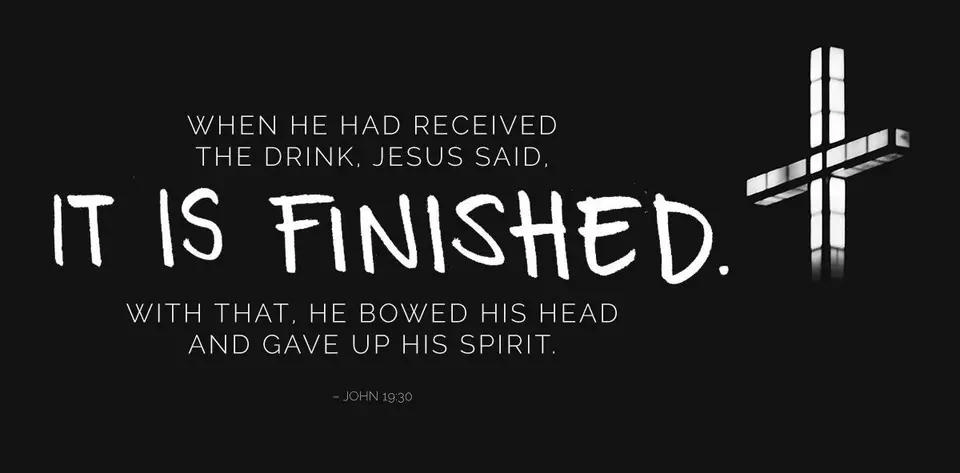
“It is Finished.” (John 19:30).